 Boletar
Porcini Field Guide
How to observe a porcini
Start with the whole scene, then move to the details. These steps help you describe observations; they do not add up to an identification.
Educational field guidance only. Boletar does not identify mushrooms or determine edibility.
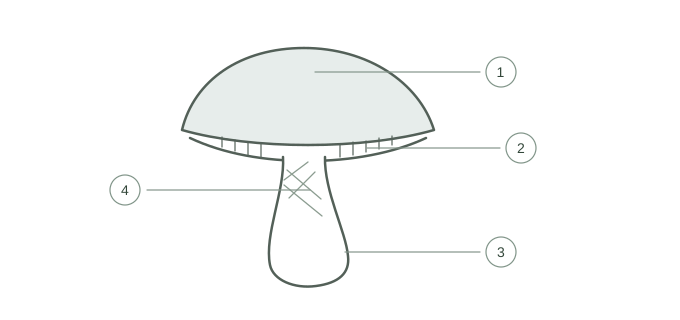
- Cap
- Pore surface
- Stipe
- Reticulum
A record, not a result
The order is a way to organize attention, not a key to work through. Do not taste an unknown wild mushroom. If you need a species assessment, ask an appropriate expert and follow their instructions about what material they need.
 (External website) Deutsche Gesellschaft für Mykologie (DGfM) · Pilzsachverständige finden (External website) Tox Info Suisse · Giftige Ammenmärchen aus dem Tox-Alltag: Pilze (External website)
From the whole scene to the detail
Begin in the habitat
Photograph the fruiting body before touching it. Include some forest floor and vegetation without publishing a private location.
Look at the cap from above
Note shape, surface texture and colour in natural light, without treating a colour as a species label.
Take in the whole profile
Look near mushroom height so the cap, margin and stipe remain in the same view.
Look beneath the cap
A small mirror may reveal the underside in place. Do not remove a fruiting body just to complete this guide.
Observe the pore surface
Note the openings, their appearance and colour. Keep the viewing angle and light in your record.
Follow the full stipe
Observe the visible upper and lower stipe. If the base is hidden, record that limitation rather than disturbing the ground.
Notice surface texture
Describe netting, texture and where each feature occurs. Reticulation is not exclusive to porcini.
Record changes over time
Note existing bruises or colour changes and the actual elapsed time. Do not deliberately damage a mushroom for the guide.
Only examine an already collected specimen
If a specimen has already been lawfully collected, a longitudinal section may show internal structure and colour reactions. Follow local collection and conservation rules; do not cut or collect solely for Boletar.
Record the wider context
Note nearby vegetation, possible host trees and habitat. Keep private coordinates private, and distinguish a suspected host from a confirmed association.
Check local collecting rules, protected-area restrictions and land-access rules independently.
A small field vocabulary
- Cap / pileus
- The upper part of a typical cap-and-stipe fruiting body.
- Pore surface
- The surface on which the tube openings are visible.
- Tubes
- The small structures beneath the cap that open as pores.
- Stipe
- The stalk supporting the cap.
- Reticulum / reticulation
- A net-like raised surface pattern.
- Flesh / context
- The internal tissue of the fruiting body.
- Bruising / staining
- Changes in appearance after pressure or exposure; note timing and conditions.
- Ectomycorrhizal
- A fungal association with plant roots.
- Fruiting body
- The reproductive structure observed above ground, not the whole fungus.